We hope you’ve seen our new dashboard (opens in new tab) on prison gerrymandering created with Lovelytics (opens in new tab) for the Tableau Racial Equity Data Hub (opens in new tab). If not, please check it out along with our previous post explaining why now is such an important time to understand what prison gerrymandering is and where change is happening.
View tweet by @tableau on X
We wanted to share details of the analysis for those interested in the data and methods. As we’ve mentioned elsewhere, this analysis was inspired by and benefited greatly from Peter Wagner and Daniel Kopf’s July 2015 report, “The Racial Geography of Mass Incarceration (opens in new tab),” published by the Prison Policy Initiative (opens in new tab). The main difference in our analysis is the focus on legislative districts, rather than counties. Legislative districts illustrate prison gerrymandering more directly but require adding another geographic layer to the analysis.
Data Sources
Most data for this project comes directly or indirectly from the Census. We start with the Census Bureau’s Topologically Integrated Geographic Encoding and Referencing (TIGER) files. (opens in new tab) These contain geographic entity codes (GEOIDs) for many types of geographies, including upper- and lower-house state legislative districts, but do not contain demographic data. We use the 2013 TIGER files which contain the legal boundaries as of January 1, 2013, which is long enough after the 2010 Census for all states to have completed the redistricting process and drawn their legislative boundaries for the 2011-2021 decade.
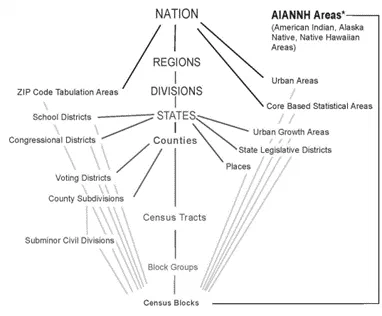
For the population of each state legislative district, including residents’ race/ethnicity, we get the 2010 Census Summary File 1 (opens in new tab) (SF1) block file, which contains population data for each census tract, block, county, etc., using the “get_decennial” function in the tidycensus package in R. The state legislative districts included in this file are from the 2006 election cycle boundaries since this file is prepared in part to aid in the redistricting process. Therefore, this file must be matched to the geography file at the block, not legislative district, level. As the graphic (opens in new tab) below shows, Census blocks are the smallest level of data collection and form the basis for all larger aggregations of Census data, including state legislative districts.
Next, data on the number of people incarcerated and their race/ethnicity comes from PPI, who have prepared, analyzed and made available data (opens in new tab) from the U.S. Census Bureau’s 2010 Group Quarters collection at the block level. According to PPI (opens in new tab), the Census Bureau does not directly publish counts of people in “group quarters” by facility type (e.g., “correctional facilities” for adults vs. student housing) or by race/ethnicity.1 Therefore, we thank PPI for the hard work of preparing these files and especially for making them publicly available. The files include state legislative district boundaries but they are again prior to the 2010 redistricting so we again need to match using Census blocks.2
The Census defines group quarters (opens in new tab) as “places where people live or stay in a group living arrangement that are owned or managed by entities or organizations providing housing and/or services for the residents.” Group quarters include prisons, military barracks, college student housing, residential treatments, nursing facilities, and more.
The last data source that we link to the legislative districts is the Open States Bulk Data API (opens in new tab), which reports what political party represents each district. Current party membership was as June 28, 2021 (the data we accessed it). The Open States district number was used to match up with the number in the US Census boundary files.
The final data source (opens in new tab), which is at the state- not district-level, is information about which states have taken action to end prison gerrymandering. The Prison Policy Initiative groups states into three categories: those that have ended prison gerrymandering at the state level for the current redistricting cycle, those that have ended it at the state level for future cycles only, and those where some local jurisdictions — but not the state itself — have taken steps to address it. As of the most recent update to this post, the picture looks like this:
| Status | States |
|---|---|
| Ended prison gerrymandering (current cycle) | California, Colorado, Connecticut, Delaware, Maine, Maryland, Minnesota, Montana, Nevada, New Jersey, New York, Virginia, Washington |
| Ended prison gerrymandering (future cycles only, e.g. 2030) | Illinois |
| Local action only — some cities/counties, no statewide reform | 200+ cities and counties across other states; PPI does not publish a definitive state-by-state breakdown of local-only action |
Source: Prison Policy Initiative (opens in new tab). PPI maintains the canonical, continuously updated list — check there for the current status.
For an interactive, map-based view of this data alongside the legislative-district-level analysis described in this post, explore the dashboard on the Tableau Racial Equity Data Hub → (opens in new tab)
Potential Data Issues or Errors
In this case, the main potential source of error comes from properly locating the 2010 blocks into their legislative districts. Spatial merging should, in theory, be perfect, but in practice differing resolutions and irregularities in the source shape files can lead blocks to be misplaced. We discuss above how we address this issue and the small number of (possibly erroneous) legislative districts we excluded. PPI has meticulously published the race/ethnicity of correctional populations (incarcerated populations) in each block, including their sources and methodology. If you are interested in examining a particular location in more detail, we recommend you view the data details on PPI’s website (opens in new tab).
Data on the political party control of legislative districts was obtained through the diligent work of the OpenStates project. Due to inconsistent identifiers used in the TIGER/Line files, not all legislative districts were able to be matched with the OpenStates data. Future work could reconcile these unmatched districts manually, but, for now, where no party control is shown on Tab 6, it is due to the limitations of the original TIGER file identifiers.
Analyses
As Jared often discusses (opens in new tab), data preparation is usually the most essential part (and 90%) of the work. After completing the data acquisition and preparation described above, most of the analyses shown on the dashboard are pretty straightforward. We do want to share some analysis notes though, especially to highlight sample restrictions where applicable.
First, the dashboard often uses the following categories: Black, Hispanic, White. These represent people who, according to the Census, identified as: Black alone; Hispanic; White alone, non-Hispanic. That means the Black and Hispanic categories are not mutually exclusive. It also means people who identify as two or more races are included in any counts of the total population (e.g., for the denominator when calculating the share of the free population who are Black) but are not included in either the Black or White category.3
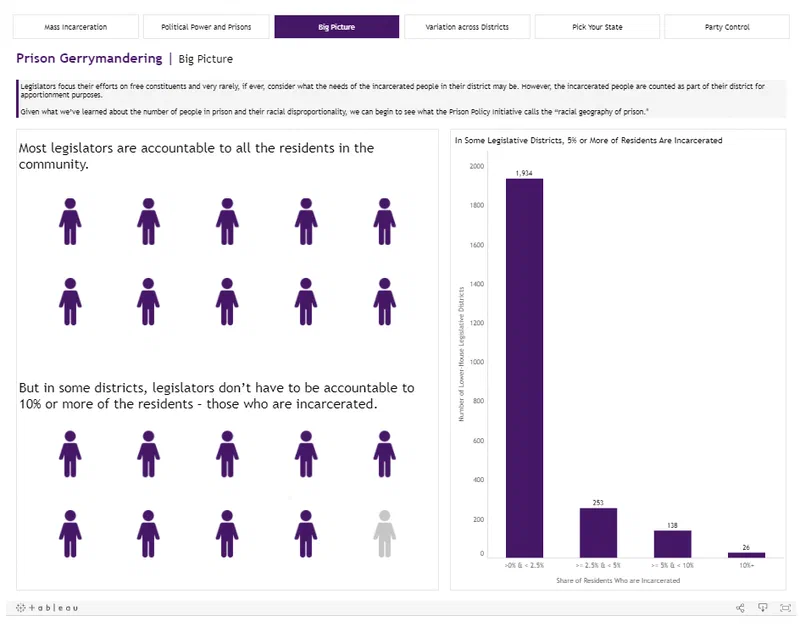
The first tab, Mass Incarceration, shows the share of the prison population who is Black (or Hispanic, depending on which category is selected) compared to the share of the free (non-incarcerated) population from that group. The “free” population is not given by the Census – we calculate it by subtracting the population in “correctional facilities” from the total population.4 The remaining calculations on this tab are straightforward (e.g., calculating incarceration rates per 1,000 members of a racial/ethnic group).
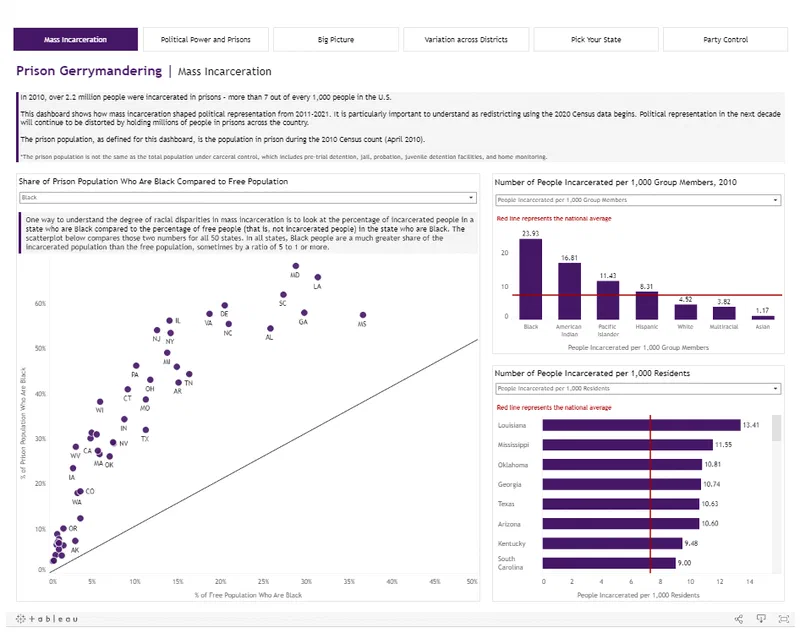
The second tab, Political Power and Prisons, introduces our first exclusion rule. The tab focuses on states’ lower-house legislative districts so Nebraska with its unicameral legislature is excluded. The tab requires a variety of calculations, including (1) the number of lower-house legislative districts per state, identified by Civilytics from the website of each state's legislature;5 (2) the average number of residents per lower-house district in each state, calculated by taking the total population and dividing it by the number of seats; and (3) the number of districts that could be formed from people in prison, calculated by summing each state’s population in “correctional facilities” and then dividing by the state’s average district population size above. On the tab, states are grouped into the four Census regions (opens in new tab).
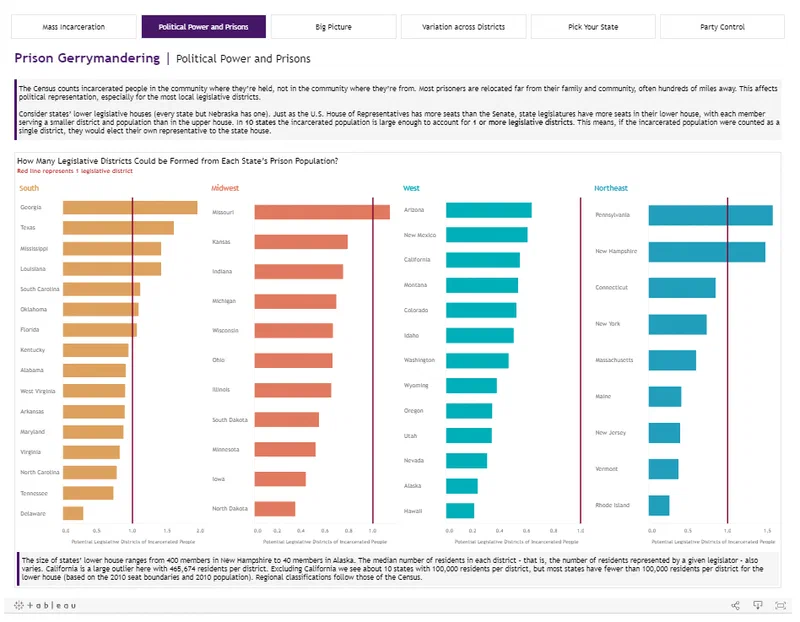
The third tab, Big Picture, shows how many legislative districts have a certain share of residents incarcerated (e.g., at least 10% of residents). This is calculated simply by dividing the number of people incarcerated in the district by the total population of the district. Because most districts do not have a prison (and, thus, do not have people counted as imprisoned within them), the chart focuses on districts that have at least some residents who are incarcerated.
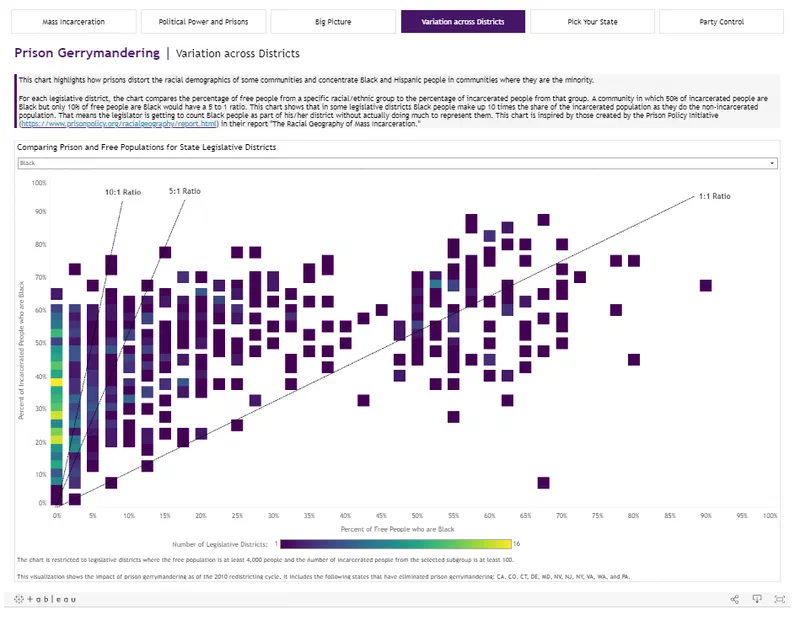
On the fourth tab, Variation across Districts, a few sample size restrictions are added to help ensure that conclusions aren’t drawn based on very small numbers of people. Specifically, the chart is restricted to legislative districts where the free (non-incarcerated) population is at least 4,000 and the number of incarcerated people from the selected subgroup (Black; White, non-Hispanic; Hispanic) is at least 100. The second restriction is based on the approach used by the 2015 PPI report (opens in new tab) on which this analysis is modeled.
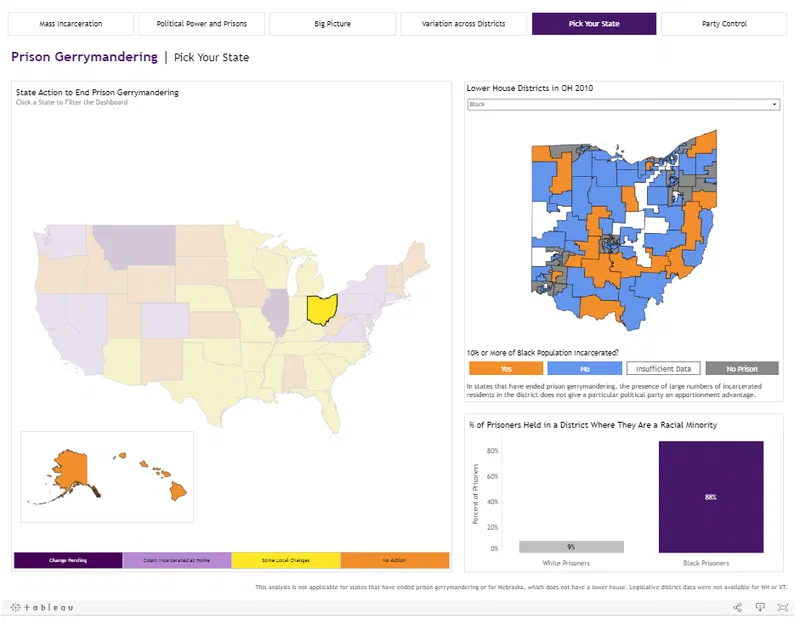
On the fifth tab, Pick Your State, the state-specific information on the right-side of the tab is not available for NE, which is again excluded because of its unicameral legislature, or for NH and VT because of misalignment with their legislative district data shape files (as mentioned above). Data are shown for some states that have ended prison gerrymandering but it’s important to remember for those states that the presence of large numbers of incarcerated residents in a district, while troubling, does not give a particular political party an apportionment advantage going forward. Legislative districts with 0 people incarcerated are shown in gray and labeled as “no prison” while those with fewer than 5 people incarcerated from the selected race/ethnicity and/or fewer than 50 non-incarcerated people from that race/ethnicity are shown in white and labeled as “insufficient data.”
For the bar chart in the lower right, incarcerated residents are coded as being in the racial minority if their selected race/ethnicity is less than 50% of the total population (including incarcerated individuals).
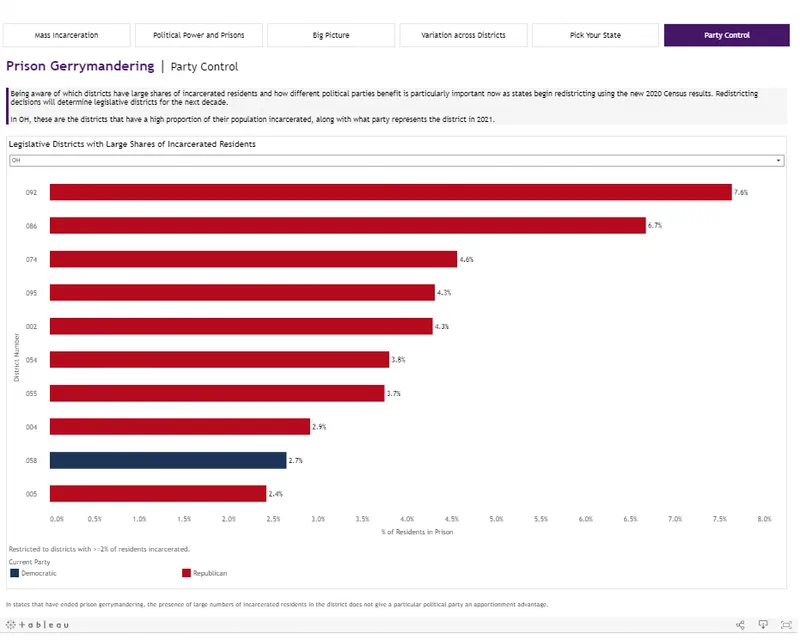
Finally, the sixth tab, Party Control, shows what political party represented districts in 2021. The graph is restricted to district where at least 2% of residents are incarcerated. NE is excluded due to its unicameral legislature. For a few states (MA, NH, VT), party affiliation of the current legislators from Open States was not able to be matched to the district names in the Census files and so is not shown.6
Additional Thoughts: Why Publish This Post?
We think it’s important to make analyses and the data preparation behind those analyses as open, public, and reproducible as possible. That means publishing the statistical scripting on git or other platforms when possible. It also means explaining the process in plain language so that someone who doesn’t read a specific type of code (R in this case) can still understand what was done and approximately how they might reproduce the work in a different programming language (something akin to literate programming (opens in new tab)).
Unfortunately this adds more work – as we discussed in this post about why we were the only fools who sunk unpaid time into understanding and documenting inequities in the ARPA funding for smaller cities and towns. But, when we can put forth the time to do this, we want to because we believe it’s critical to advancing transparent work on important issues facing the public.
We hope to see more groups and companies discussing why this matters and taking this approach.
We only include what PPI classifies as “institutionalized adult, correctional.” This excludes juvenile facilities and non-institutionalized forms of incarceration (e.g., home monitoring). ↩︎
We dropped 6 legislative districts that had no proper name in the TIGER files and were matched with 0 Census blocks. In two states there were Census blocks that had no overlap with a legislative district, but this resulted in only 1 incarcerated person being excluded from the analysis. ↩︎
Race/ethnicity itself is complicated, and so is working with the race/ethnicity data in the Census. We would like to contribute to more clearly specifying what decisions we made in using the race/ethnicity categories and what limitations result. ↩︎
We use the adult incarcerated population because prison gerrymandering is affecting this group the most. However we use the total population of the district because legislative districts are drawn proportional to the whole population, not the voting age population. ↩︎
For states with multi-member districts – that is multiple representatives elected for the same physical boundary (i.e., AZ, NH, NJ, SD, WA) – we included the number of people per representative, not per legislative district. For more information about states with multi-member districts, see https://ballotpedia.org/State_legislative_chambers_that_use_multi-member_districts (opens in new tab). ↩︎
Party ID was also missing for 1 district in WI, 1 in OH, 1 in MI, 1 in ME, 1 in MD, 1 in LA, and 2 in AL. ↩︎